


Retro Gaming is Booming in 2025
Retro gaming has never been more popular than it is right now. The once unpopular, niché hobby that used to be considered something only for nerds has become so popular in recent years, that it’s basically mainstream now. Video gaming in general is a massive industry, it’s bigger than the Hollywood movie and music industry combined in terms of popularity and generated income.
Speaking of the movie industry there have been many movies based on video games in recent years that are extremely popular, titles such as the Super Mario Bros Movie (2023), Sonic the Hedgehog (2020), A Minecraft Movie (2025) and Tetris (2023) have been incredibly successful not just because they were all very good films but because they appealed to the nostalgia of a large demographic of people who are now in their 30’s and 40’s.
Old games get re-released on new consoles both in physical and digital form, they continue to live on with new and old gamer’s that are (re)discovering the joy of these classics. All these things are keeping retro gaming alive and healthy in the present day and more popular than ever. The best thing about the present age is what our current technology can do when it’s applied and combined with retro gaming. One of the ways that new technology has been combined with retro gaming is a new tech that is called FPGA.
Retro Gaming and FPGA
FPGA or Field Programmable Gate Array is recently developed technology that is the biggest development in retro gaming technology since emulation. It does the same thing as emulation but it does it much better. It recreates classic, original gaming hardware at the silicon level providing gamers with pixel-perfect accuracy and zero lag resulting in a completely authentic gaming experience. It actually is completely indistinguishable from the original hardware and often provides modern technology upgrades such as HDMI, Network and USB capability. It literally brings retro gaming into the modern high-tech era.
The other benefit is that it is newly produced hardware which means it will last far longer than the aging original gaming hardware which can be up to 40 years old or more now. FPGA truly is a modern miracle for retro gaming and a God-send for retro gamers. It’s also very beneficial for the retro gaming market which keeps rising as demand grows and supplies shrink, with FPGA there is now new hardware available which provides some relief on the heavy demand for the original, again technology.
Top 5 FPGA Systems Driving the Retro Gaming Revival
We will now take a look at just 5 of the many, many FPGA systems out there that are making big waves in the retro gaming world.
1. ModRetro Chromatic

Specifications
- Display: 160 x 144 IPS Backlit LCD with Sapphire or Gorilla Glass
- Build Material: Magnesium Alloy Thixomolded Shell
- FPGA Chip: GOWIN GW5A-25
- Audio: Custom Ultra Loud Speaker Module and 3.5mm Headphone Output
- Battery: 3x AAA Batteries or ModRetro Power Core. Approx 19 Hours playtime.
- Compatibility: GB, GBC and ModRetro Game Cartridges
An excellent, modern Game Boy Color that play’s original cartridges for the DMG as well as the Game Boy Color. The screen is made to have the exact original resolution of the original GBC unlike other FPGA consoles which just scale down the resolution of a much larger screen, resulting in pixel perfect reproduction but with a backlight. The alloy shell is much tougher than plastic (which the original used) and is very likely to survive to being dropped without any damage to the circuitry at all. It has a USB port which can connect to a PC to update firmware, update ModRetro games and record or stream gameplay. It is well supported with many accessories available, including a power pack that can be recharged via USB cable otherwise it will work using 3x AAA batteries (normal or rechargeable). It comes with a new version of Tetris released by ModRetro and there are a range of ModRetro branded games available. I believe this is the best FPGA Game Boy Color console available.
Price Range: From $199 to $299 (US) / $355 to $535 (AU)
2. SuperStation One

Specifications
- Display: HDMI (up to 1536p/1440p), VGA, DIN10 (RGB, Composite, Component) and RCA
- FPGA Chip: Intel Cyclone V SoC FPGA with HPS Cortex A9 Dual-Core @ ~800 MHz
- Audio: TOSLINK Digital Optical Audio Output, 3.5mm Audio Output Jack
- Memory: 128 MB BGA SDRAM.
- Storage: Pre-installed 64 GB MicroSD card, USB ports, Expansion slot for M.2 2280 SSD (via optional SuperDock), Optional CD/DVD drive via SuperDock (for original PS1 discs).
- Compatability: Region-free support for PS1 games and compatibility with MiSTer FPGA cores
The SuperStation One very much resembles a PS One in appearance, it lets you play original PlayStation games via a 64 GB Micro SD card which comes with the system. You can’t play your PSX game discs unless you purchase and connect a “SuperDock” accessory which comes with a CD drive as well as an expansion slot for an M.2 2280 SSD and four additional USB-A ports. It has ports for original PlayStation controllers and memory cards, so together with the SuperDock has all the functions of an original PS One making for an authentic retro gaming experience. It also has three USB-A ports, an ethernet port for networking capability and an NFC reader for instant game loading via card. As well as being a fully compatible PlayStation it is also compatible with MiSTer FPGA cores so it can also run games for many other retro consoles.
Price Range: $199 (US) for the SuperStation One. $45 (US) for the SuperDock Accessory.
3. Analogue 3D

Specifications
- Display: HDMI Output (4K Resolution), Variable Refresh Rate Support
- FPGA Chip: 220k LE Altera Cyclone 10GX @ ~300 MHz
- Audio: Supports 48 kHz 16-bit PCM Audio (via HDMI Output)
- Storage: Pre-installed 16 GB SD card included
- OS: Runs 3D OS (Analogue’s Own OS) in 4K
- Compatibility: Region-free and Supports Original Controllers and Accessories
The Analogue 3D is a Nintendo 64 clone that output’s display in 4K with 100% compatibility with original hardware and software and promises the most accurate, non-emulation gaming experience. It brings Nintendo’s classic multiplayer console to the modern era with outstanding display, full compatibility, SD card ROM loading with a custom OS and updated joystick design by 8BitDo. It features built-in memory packs and expansion pack, blue tooth and Wi-Fi compatibility, USB ports and USB-C power connection. It can play all the original Nintendo 64 cartridges and is completely region free.
Price Range: $249 (US) for the Analogue 3D. $39 (US) for an 8BitDo 64 Controller (sold seperately).
4. ZX Spectrum Next

Specifications
- Processor: Z80N at 3.5MHz with turbo modes at 7MHz, 14MHz and 28MHz
- FPGA Chip: Xilinx Artix-7 XC7A35T
- Display: RGB, VGA, HDMI, 50Hz and 60Hz modes
- Audio: 9-Channel Sound via Three Stereo AY-3-8912, Plus Two x 4-Bit DACs
- Storage: 1 x SD Card slot, with DivMMC-Compatible Protocol, 1 x Internal MicroSD Card Slot
- OS: NextZXOS and NextBasic, Featuring An Expanded Command Set
- Compatibility: Full ZX Spectrum Family Compatibility
The ZX Spectrum Next is not just a clone system like previously mentioned systems, it can run all ZX Spectrum family software however it is also it’s own system. This system separates itself from the others as it is the only system in the list that is also a unique platform with it’s own specifications. It is called the ZX Spectrum Next because it is designed to be the next iteration of the ZX Spectrum if Sinclair had made another system after the ZX Spectrum 3+. The new platform is very impressive with much improved graphics and sound, capable of creating games that look nearly as good as 16-bit games. Additionally the system has many computer cores apart from the ZX Spectrum family, it is compatible with Amstrad CPC, Commodore 64, Sam Coupé and Pico-8 software with more in development. It is up to it’s 3rd iteration and only available via Kickstarter campaign pledges but there are two clone systems available – the N-Go and the eLeMeNt ZX.
Price Range: £300 (GB) / $600 (AU) Base Model. £320 (GB) / $640 (AU) Accelerated Model. £340 (GB) / $680 (AU) Magenta Accelerated Model.
5. MiSTeR FPGA
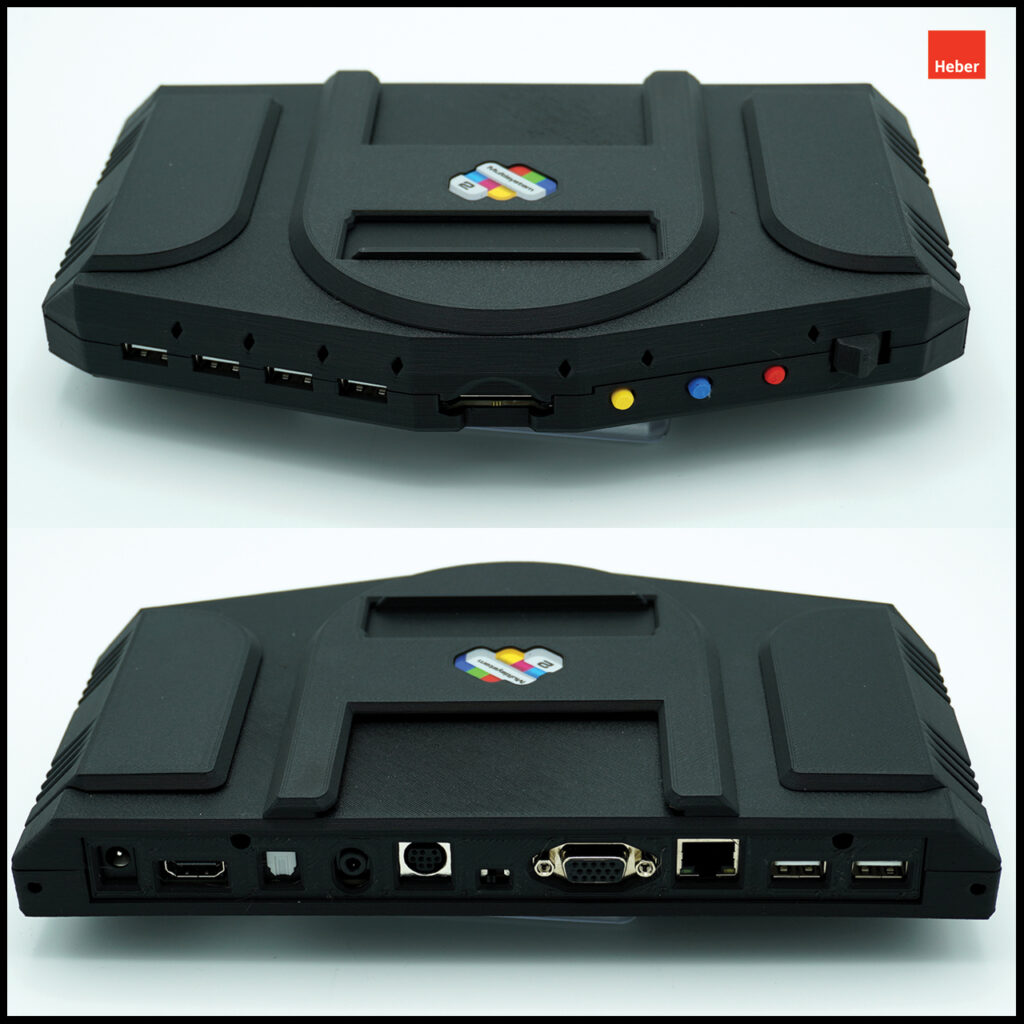
Specifications
- Processor: Dual ARM Cortex-A9 (HPS processor) @ ~800 MHz
- FPGA Chip: Intel (Altera) Cyclone V SoC
- Memory: 1GB DRR3, Optional 32 MB / 64 MB / 128 MB / 256 MB SDRAM Expansion
- Display: HDMI Output (Full HD 1920×1080 @ 60 Hz), VGA Output (DB15 Connector)
- Audio: PCM audio over HDMI; Optional Analog Audio via IO Board DAC (3.5mm Jack)
- Storage: MicroSD Card Slot, USB Storage Support (through USB Hub)
- OS: MiSTer Linux OS
- Compatibility: Supports hundreds of FPGA cores including:
NES, SNES, Genesis, PC Engine, Neo Geo, PlayStation 1, Game Boy / GBC / GBA, Amiga, C64, Atari ST, arcade boards (Capcom, Konami, Sega, Taito, etc.), and many 8-bit microcomputers.
The MiSTer FPGA is a modular, open-source platform that recreates classic consoles, computers, and arcade systems in hardware rather than software. Built around the Intel Cyclone V FPGA with a dual-core ARM processor, it delivers cycle-accurate performance and ultra-low latency. With support for hundreds of cores — from the NES and Amiga to the PlayStation 1 and Neo Geo — it’s the most versatile FPGA system ever made. Constant community development and easy expandability have made MiSTer the gold standard for serious retro gamers and preservationists.
Price Range: $150 – $250 (US) for an Entry Level Kit, $400 – $500 (US) for a Mid-Range Setup, $600 – $800 (US) for a Premium Setup.
Relevant Links
- Buy the ModRetro Chromatic [https://modretro.com/products/chromatic-tetris-bundle] Currently available to purchase
- Buy the SuperStation One [https://retroremake.co/products/superstation-one] Currently available to purchase
- Buy the Analogue 3D [https://www.analogue.co/3d] Currently out of stock
- Buy the ZX Spectrum Next clone the N-Go [https://manuferhi.com/c/n-go] Currently only avaialable in parts
- Buy the ZX Spectrum eLeMeNt [https://shop.elementhw.com/element-zx/] Available as board only
- Buy the ZX Spectrum Next [https://www.kickstarter.com/projects/spectrumnext/zx-spectrum-next-issue-3-0] Kickstarter campaign has finished, you can no longer purchase it here.
- Buy the MiSTeR FPGA [https://shop.heber.co.uk/mister-multisystem/] Currently available to purchase

